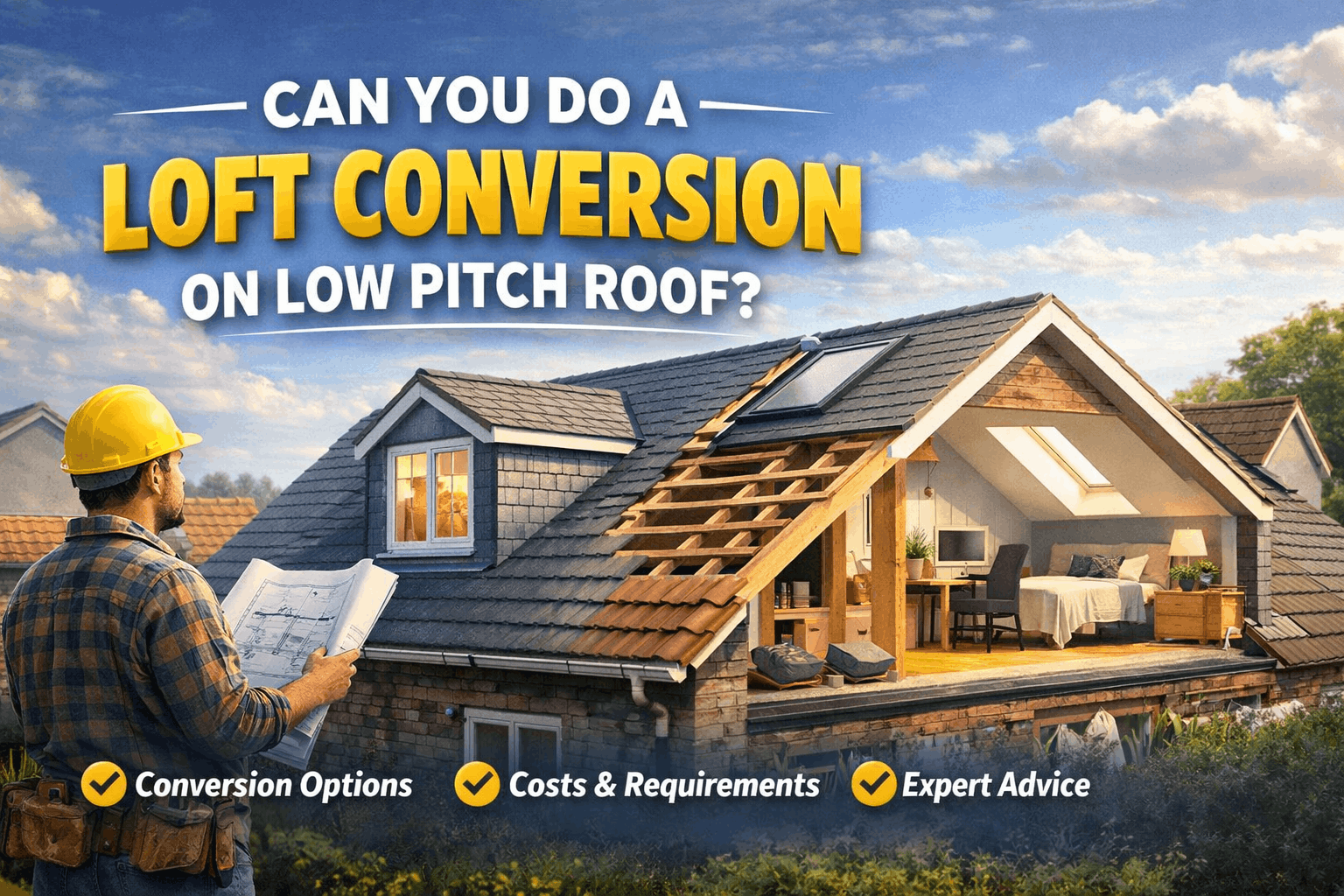
It might be a challenging task if you are planning a loft conversion on low pitch roof. Many of you may have low-pitch roofs and not be sure whether a conversion is even possible, whether it’s worth the investment, and what it will cost to get it done. If you have these types of questions in mind, this blog post will help you explore different options and understand the possible costs involved to make an informed decision about transforming your loft space.
If you are ready to start your loft conversions in North London, you can get in touch with GTB Builders. Stop wasting time searching for quotes, start planning your loft conversion today with us.
What happens if the roof pitch is too low?
Many people choose low-pitch roofs as an alternative to a flat roof. However, if it comes with various benefits, it also comes with some disadvantages, such as difficulty draining, debris can build up on the tiles, or roof tiles may become loose.
Is a loft conversion on low pitch roof Possible?
The short answer is yes. A loft conversion on a low-pitch roof is possible, but there are a few things to consider. If the pitch of your roof is below 30 degrees or the internal height is less than 2.2 metres from the floor to ceiling, the conversion may not be possible without making structural modifications. In these cases, lowering the ceiling below or raising the roof might be required, both of which add to the cost and complexity. However, when a loft conversion on low pitch roof is feasible, it comes with several benefits:
- It increases underutilised space, adding valuable living spaces like an office or bedroom without an extension requirement.
- It improves the property’s value dramatically, usually providing a high return on investment.
- With proper planning and design, you can have a comfortable and bright room by including dormers, roof lights, or other creative solutions to increase natural light and headroom.
What is the 10 year rule for loft conversion?
The 10-year rule in the UK means that if you constructed a loft conversion without the required planning permission, but no one took action against it for 10 years, it usually becomes legally accepted, and you are allowed to apply for a certificate to prove it’s lawful. For instance, if a commercial building has been utilised as a dwelling for more than 10 years without required planning permission, the local authority won’t be able to take any action against that unauthorised change of use. The homeowner can then apply for a Certificate of Lawfulness, which confirms that the use is now lawful.
What loft height is too low for a conversion?
As per the building regulations, the minimum height which is required for a loft conversion from the floor to the highest point is 2.2 metres. If your ceiling meets the minimum height needs, you will be able to convert your loft into a suitable living space. Make sure to follow these rules not only to comply with the law but also to ensure that the converted space is functional and safe.
What is the best roof pitch for loft conversion?
Here, we’ve listed the main types of loft conversions you can select from for a low-pitch roof:
- Dormer loft conversion
- Velux loft conversion
- Hip-to-gable loft conversion
- Mansard loft conversion
While each roof pitch has its benefits, the dormer loft conversion is usually considered the ideal roof pitch for a loft conversion for low-pitch roofs because it can maximize headroom, making it a popular choice.
Velux loft conversion
Velux loft conversions are considered the most cost-effective option for low-pitch roofs. In this type of loft conversion, there’s no need to change the structure of your roof. Instead, roof windows are installed, allowing natural light in. If you are looking to create a bright space like a guest room or a home office, you can choose a Velux loft conversion.
Dormer loft conversion
A dormer conversion is ideal for low-pitch roofs because it creates usable floor space and additional headroom. It extends the roof vertically, providing more space and better natural light. It is ideal for various property types and can be constructed at the rear, front, or side of the house. It is especially ideal for low-pitch roofs because it solves the issue of limited headroom.
Hip-to-gable loft conversion
A hip-to-gable conversion extends the sloping side of your roof to create a vertical wall, called the gable. This maximizes the internal loft space and is suitable for a hipped roof.
Mansard loft conversion
A mansard loft conversion is an ideal option for raising the entire slope of your roof to form near-vertical walls. It can maximize the internal space, allowing you to create functional and large rooms.
Conclusion
If you have a low-pitch roof, you can have various loft conversion options as mentioned in the blog. You can contact GTB Builders for a loft conversion on a low-pitch roof.
Other Useful Links
Roof Leak Repair: What to Do and When to Call an Expert